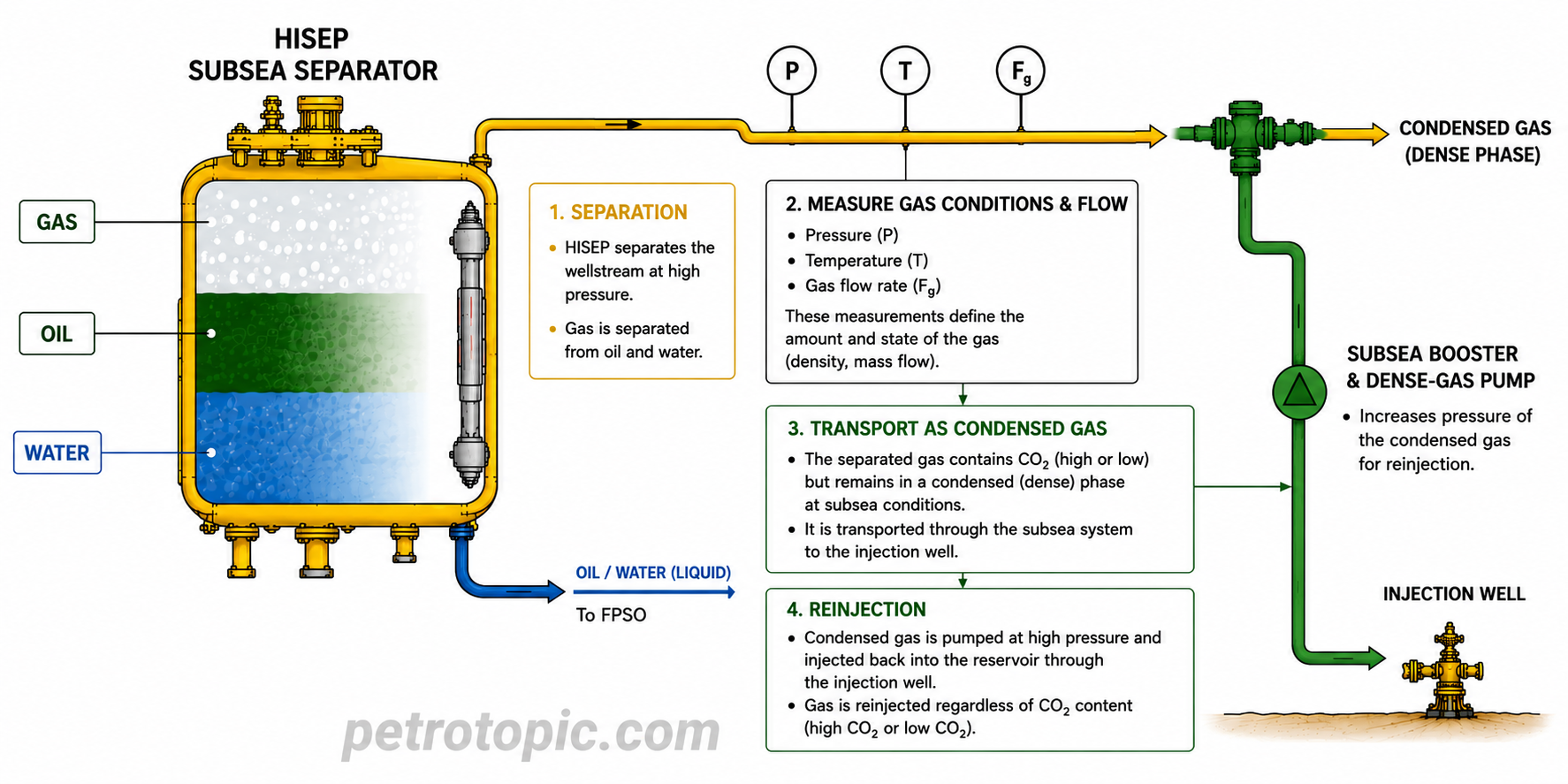
Brazil's pre-salt fields contain significant amounts of CO₂ in the produced gas. This creates an important production challenge because the associated gas must normally be separated, treated and handled by the topside facilities of an FPSO. As gas production increases during field life, the gas-processing system can become a limitation on oil production.
The HISEP® (High Pressure Separation) technology developed by Petrobras addresses this problem by moving part of the separation process from the FPSO to the seabed. The Mero 3 project is the first application of Petrobras' patented HISEP® technology in the Brazilian pre-salt. Petrobras describes the system as a subsea process that separates CO₂-rich associated gas from the produced oil and enables the gas to be reinjected into the reservoir from the seabed.
How HISEP® Works
The basic process is relatively straightforward:
Production well → HISEP® separator → CO₂-rich dense gas → subsea boosting/pumping → injection well
The production stream arriving at the subsea separation station contains oil together with natural gas and CO₂. Inside the HISEP® separation system, the oil is separated from the CO₂-rich gas at high pressure.
The separated oil is sent toward the FPSO, while the CO₂-rich gas remains subsea. The gas is transferred to a subsea boosting station, where it is scrubbed and cooled before entering a high-pressure dense-gas pump. It is then reinjected into the reservoir. TechnipFMC identifies four major technologies enabling the subsea system: the separation station, boosting station, high-voltage power distribution and dense-gas pump.
This arrangement provides two major benefits. First, it reduces the gas-processing load on the FPSO, effectively debottlenecking the topside gas-processing plant. Second, it allows CO₂-rich gas to be reinjected without first bringing the entire gas stream to the surface for processing. TechnipFMC states that the HISEP® solution developed for Mero 3 can reduce CO₂ emissions intensity during production by up to 30%.
How Is the Gas Measured?
One of the interesting aspects of HISEP® is the measurement required inside the subsea separator.
In 2025, Tracerco announced that it had been selected by TechnipFMC to provide its Tracerco Profiler™ measurement and control system for the multiphase subsea separation system of the Mero 3 HISEP® pilot.
The Profiler is a nucleonic measurement system designed to provide real-time information on the distribution of gas, oil and water inside a vessel. It effectively provides a "window" into the separator by measuring the distribution and density of the different phases.
Therefore, the measurement concept can be simplified as:
HISEP® separator
↓
Profiler
↓
Gas / oil / water phase distribution
↓
Gas separation and process control
The important point is that the Profiler is primarily a phase/density measurement instrument. It should not be interpreted as a direct CO₂ composition analyzer. Tracerco describes the instrument as measuring the vertical distribution of gas, oil, water, foam, emulsion and sand; its published description does not identify it as a direct CO₂ concentration meter.
What About the CO₂ Concentration?
This is an important distinction.
Mero is widely described as a high-CO₂ pre-salt field, and HISEP® is specifically designed to remove CO₂-rich dense gas from the produced stream. However, the publicly available Mero 3 HISEP® information does not clearly disclose the detailed instrumentation and measurement philosophy used to determine the real-time CO₂ mole fraction of the separated gas subsea.
Consequently, it would be incorrect to state simply:
"The Tracerco Profiler measures the CO₂ concentration."
It does not appear to do that.
Instead, the publicly confirmed measurement function is the identification and control of the gas/liquid phases and their distribution within the separator. The actual CO₂ composition measurement, sampling strategy, fluid-composition model or other metering technology used for CO₂ accounting is not fully disclosed in the public HISEP® documentation reviewed here.
This distinction is particularly important when discussing CO₂ mass flow. Knowing the gas flow rate alone does not establish the amount of CO₂ being reinjected:
CO₂ mass flow = total gas mass flow × CO₂ mass fraction
Therefore, a complete CO₂ accounting system requires both the quantity of separated gas and reliable information about its composition.
Is HISEP® Injecting "Condensed Gas" Regardless of CO₂ Content?
The more accurate description is CO₂-rich dense gas rather than simply "condensed gas."
TechnipFMC explains that the HISEP® system separates CO₂-rich dense gas directly from the wellstream. The separated dense gas is then boosted and pumped back into the reservoir.
The objective of HISEP® is therefore not to selectively remove only pure CO₂. It is to separate a CO₂-rich gas phase from the produced fluids and reinject that dense gas.
In other words:
Wellstream
→ HISEP® separation
→ CO₂-rich dense gas
→ subsea booster / dense-gas pump
→ reservoir injection
The public information does not support the idea that HISEP® continuously measures the CO₂ percentage and then decides whether individual portions of gas should be injected or rejected. Rather, the process is designed around handling the CO₂-rich dense-gas stream as a process stream.
Why This Technology Is Important
HISEP® is significant because it changes the traditional architecture of offshore production.
A conventional concept is:
Subsea wells → FPSO → separation → gas treatment → CO₂ handling/reinjection
HISEP® moves part of that process to:
Subsea wells → subsea high-pressure separation → CO₂-rich dense-gas reinjection
This can free capacity on the FPSO, reduce the amount of gas that must be processed topside and potentially reduce the size and weight of future surface facilities.
Petrobras and TechnipFMC describe Mero 3 as the first subsea application of the HISEP® process. Petrobras' current planning documents indicate that the Mero 3 HISEP® pilot is expected to begin first oil in 2028, making the project an important demonstration of subsea high-pressure CO₂ separation and reinjection.
Conclusion
The key takeaway from Mero 3 HISEP® is that CO₂-rich gas separation and reinjection can be performed at the seabed instead of relying entirely on the FPSO.
The system separates the produced fluids at high pressure, measures and controls the gas/oil/water phases, transports the separated dense gas through subsea equipment, and uses a high-pressure dense-gas pump to reinject it into the reservoir.
The Tracerco Profiler™ is an important part of the subsea measurement system, providing real-time multiphase information inside the separator. However, it should not be described as a direct CO₂ concentration analyzer. The exact method used in the final Mero 3 system to establish the CO₂ fraction for detailed CO₂ mass accounting remains an interesting area where publicly available technical information is limited.
This is perhaps one of the most interesting engineering questions surrounding HISEP®: separating CO₂-rich gas subsea is one challenge; accurately quantifying how much CO₂ is actually being separated and reinjected is another.